Vehicle Inventory
Register every unit with purchase details, documents, photos and status — from intake through workshop to sold.



Recondition is a complete management system for vehicle reconditioning businesses. Purchase, parts, vendor work, in-house labour, holding costs and the final sale — all attached to the vehicle, so real profit appears the moment the unit is sold.
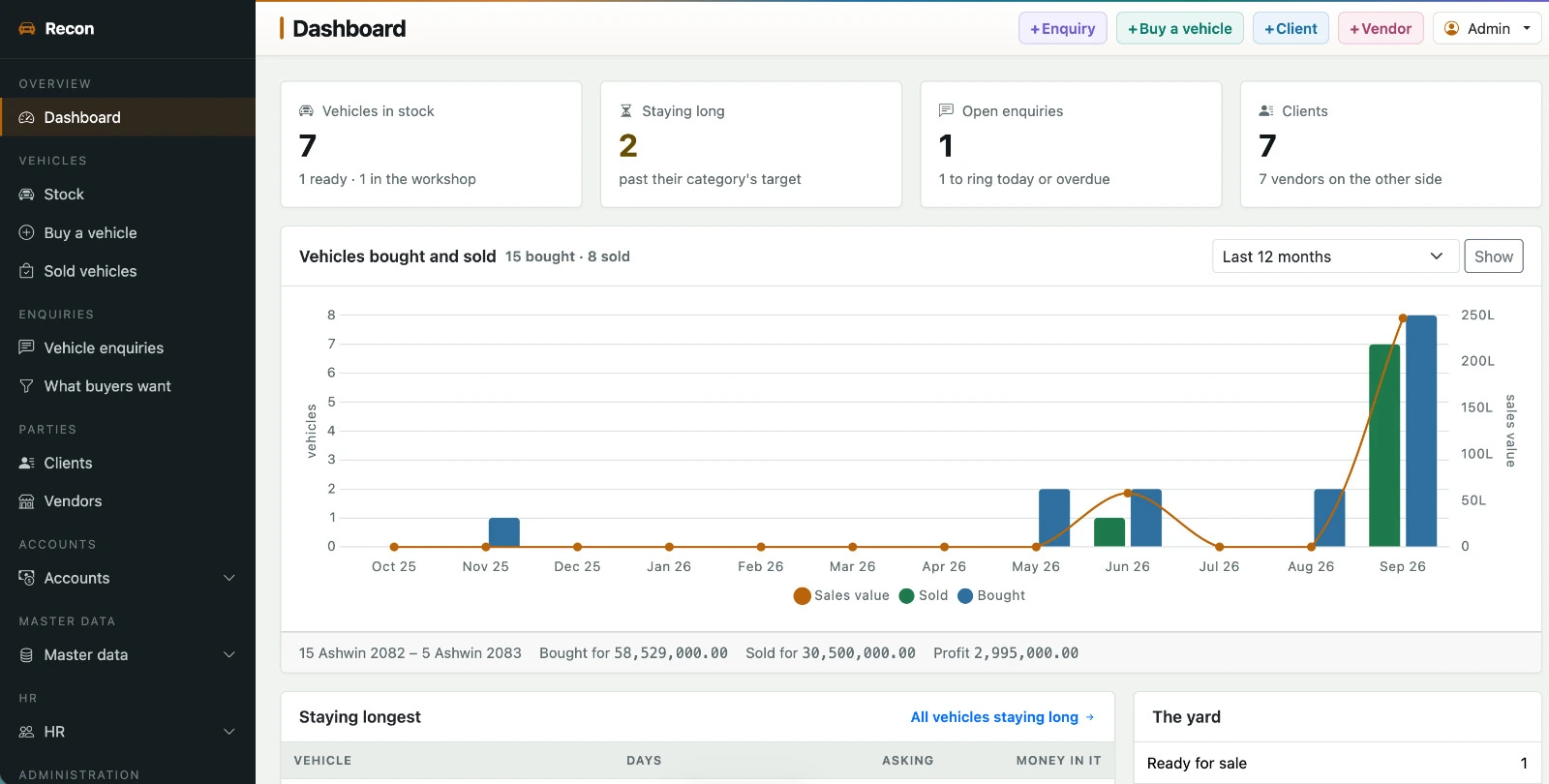
Each module writes to the same vehicle. That single decision is what makes accurate profit and loss possible without anyone re-typing a number.
Register every unit with purchase details, documents, photos and status — from intake through workshop to sold.
Acquisition, reconditioning and holding costs roll up against the sale price to give a true margin for every single vehicle.
Ledgers, expenses, payments and receipts — every entry carries a Vehicle field so nothing lands in a general bucket.
Job cards for panel, paint, mechanical and detailing work, with parts issued and hours booked straight to the vehicle.
Staff, attendance, pay rates and timesheets — in-house labour cost is calculated and bridged to the vehicle automatically.
Workshops, parts suppliers and transporters with their bills, dues and performance history in one place.
Buyers, enquiries, quotations and sale records — the sale is linked to the client and back to the vehicle.
Listings, campaigns and lead sources, so you can see which channel actually brings the buyers that close.
Per-vehicle margin, monthly summaries across the whole fleet, and vendor or recon cost breakdowns.
A monthly total tells you the business made money. It does not tell you which unit carried the month and which one quietly ate it. Recondition attributes every cost event to a vehicle as it happens.
P&L = Sale price − (Acquisition + Reconditioning + Holding)
Move the values and watch the margin update. NPR.
Create the vehicle record with purchase price, fees and transport. The stock ID is born here.
Raise job cards. Issue parts, send work to vendors, book staff hours against the vehicle.
Every bill, timesheet and expense already carries the Vehicle field — nothing to reconcile later.
Link the sale to the client record, record the price, close the unit.
Per-vehicle margin, monthly fleet summary and vendor cost breakdowns, generated instantly.
Accounting, HR and vendor data share the same vehicle. Side spreadsheets stop being necessary.
A vendor bill is entered once and appears in the vehicle's cost sheet, the ledger and the vendor's dues.
Timesheet hours multiplied by pay rates land on the vehicle, so in-house work is never free.
Know your true floor price before you negotiate, backed by the actual spend on that unit.
Compare what each workshop costs you across dozens of vehicles, not on memory.
Reports are a click, not a week of collecting bills and matching them to units.
No. The accounting module works the way your team already does — the single addition is a Vehicle field on expense, bill and payment screens, which is what makes the per-vehicle roll-up possible.
Staff book hours against a vehicle's job card. The system multiplies those hours by the employee's pay rate from HR and posts the amount as a reconditioning cost on that vehicle.
Yes. Unsold vehicles show accumulated cost and holding days, so you can see what is tied up in the yard and how long it has been sitting there.
Per-vehicle margin reports, monthly summaries across all vehicles, and vendor or recon cost breakdowns — plus the standard accounting, HR and client reports from the other modules.
Recondition is built and maintained by Web House Nepal, so cost categories, approval flows, report formats and user roles are shaped around how your yard actually runs.
We will walk through your vehicles, your cost heads and your reports — then show exactly how the system handles them.