


Boosting Posts Is Not Running Ads:The Difference That Costs You Money
Under every post your Facebook page publishes there is a small blue button that says Boost Post. Tap it, choose an amount, pick an audience in a couple of taps, confirm, and within an hour your post is reaching a few thousand more people. The whole process takes about as long as ordering a cup of tea.
We talk to business owners every week who have been boosting posts for years. Restaurant owners, school administrators, hardware suppliers, hotel managers. When we ask them about their Facebook ads, they point to that button. In their mind, boosting is Facebook advertising.
It isn't. Boosting is the shallow end of Facebook advertising, and the button is designed to make sure you never find out how deep the pool actually goes.
Proper advertising on Facebook and Instagram happens inside Meta Ads Manager. That is where you decide what a campaign is for, who sees it, where it appears, and, most importantly, what Meta should be trying to get you. Boosting quietly makes most of those decisions on your behalf. That's convenient, and it's also the reason a lot of ad money in Nepal ends up buying likes instead of customers.
This post walks through the difference in practical terms so you can work out which one your business should be using.
What the Boost button actually does
When you boost, you're giving Meta a very simple instruction: take this post I already published and show it to more people. You get a handful of goals to choose from (usually more messages, more engagement, more profile visits or more website clicks), some basic targeting by location, age, gender and broad interests, a daily budget and an end date. That's more or less the whole menu.
What's missing is nearly everything that makes advertising actually work.
Start with the objective. In Ads Manager you can tell Meta exactly what a good result looks like: a purchase, a form fill, a WhatsApp conversation that turns into a booking. Boosting mostly optimises for engagement, so Meta goes looking for people who are likely to react and comment. It's very good at finding them. The trouble is that people who like posts and people who buy things are not the same people, and Meta will happily give you a lot of the first kind if that's what you asked for.
Then there's the audience. Ads Manager lets you build a custom audience from people who visited your website, upload your existing customer list, create lookalikes of those customers, and retarget someone who looked at your pricing page and left. None of that exists behind the Boost button. You're always advertising to strangers, every single time.
Placement is the third gap. A boosted post gets pushed across the feed, Stories, Reels and Audience Network whether the creative suits those formats or not. A square image made for the feed looks cramped in a vertical Story, but you're paying for those impressions anyway.
And you can't test anything. It's one post, one audience, one version. When it finishes you have a reach number and a few reactions, and no idea what would have happened with a different headline or a different age range. Nothing you learn carries over to the next one.
Finally, without the Meta Pixel feeding conversion events back into a campaign that's built for conversions, Meta has no idea which of your ads produced real business. It optimises blind, and so do you.
Where the money actually goes
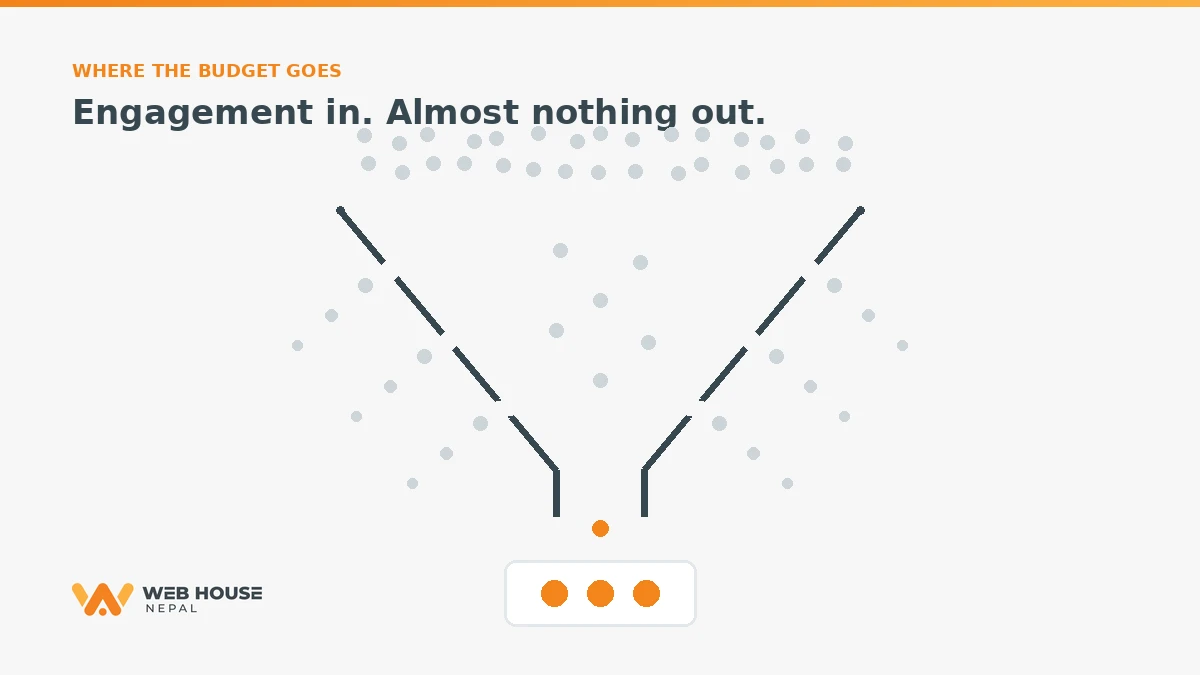
The cost of boosting isn't the Rs 2,000 you put behind the post. It's what that Rs 2,000 fails to do.
Take a private school in Lalitpur that boosts its admissions-open post every year. The post gets 300 reactions, 40 comments (mostly "fees?" and tagged friends), and the admin team is pleased. The number of parents who actually called or filled in an enquiry form is not something anyone can tell you, because the boost was never set up to measure it. Two hundred reactions and no enquiries is not a boost failing. It's a boost doing precisely what it was told to do.
The second half of the funnel is missing too. Most people don't buy the first time they see you. Someone sees the boosted post, is mildly interested, visits the website, and leaves. In Ads Manager that person drops into a retargeting audience and sees a follow-up ad the next day. With boosting, they simply vanish. You paid to get their attention once and have no way to get it back.
And nothing compounds. Every boost is a one-off. No audience gets built, no learning phase completes, no data accumulates. Next month you spend the same amount to reach the same cold crowd again, and the month after that, and so on for years. When people tell us boosting is cheaper, this is usually what they're not counting. Boosting is faster to set up. That's a different thing from being cheaper per customer, and over a year the gap between those two adds up to a lot of money.
When boosting is perfectly fine
We're not saying never touch the button. It has a narrow job and it does that job well.
If a post is already doing unusually well on its own, a small boost to push it further makes sense. A staff photo that took off, an award, a news mention. The organic signal is already there; you're just extending it.
If the goal really is visibility and there's nothing to measure, boosting is adequate. An opening-hours change, an event date, a Dashain greeting with a few hundred rupees behind it. Building a proper campaign structure for that would be overkill.
What boosting should never be is the whole strategy. If the only paid thing your business does on Facebook is boost, you're running your marketing on the simplest tool Meta offers and leaving the useful ones untouched.
What Ads Manager gives you instead
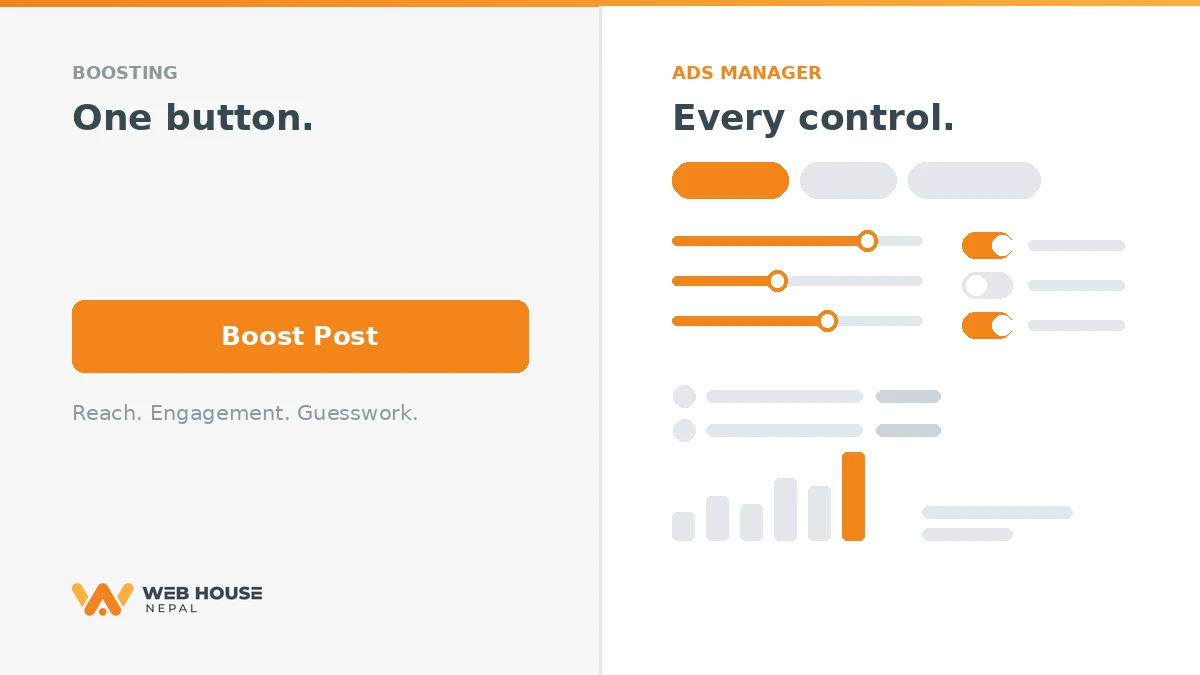
Ads Manager is free. What it costs is a few evenings of learning, or the fee of someone who has already done that learning.
The first thing you get is a campaign objective that actually matches your business goal. Leads, sales, traffic, messages. Each one changes who Meta goes looking for. A leads campaign hunts for people who fill in forms; an engagement campaign hunts for people who like things. Picking the right one is the single biggest lever in the whole system, and it's the one boosting takes away from you.
The second is audiences that get better over time. Website visitors, video viewers, customer lists, lookalikes. Each campaign feeds the next, so your targeting sharpens and your cost per result generally drops rather than staying flat.
Retargeting deserves its own mention because it's where most of the profit lives. The people who already visited your site or messaged your page are the cheapest customers you'll ever acquire. Boosting can't reach them specifically. Ads Manager can, for a fraction of what it costs to find a new stranger.
Then there's testing (two headlines, two images, two audiences, and after two weeks you know which one works), placement control with creative built for each format, and reporting that tells you cost per lead or cost per message instead of "reach", which is a number that feels good and tells you almost nothing.
The Nepal-specific problem: paying Meta
There's an honest reason so many Nepali businesses stay on the Boost button, and it isn't laziness. It's payment.
Meta bills in US dollars, so you need an international payment method. Nepal's foreign currency card rules are tighter than in most markets, the limits are modest, and the provisions from Nepal Rastra Bank change from time to time. Boosting through the app with a card that's already saved feels a lot simpler than setting up a proper business billing account and worrying about whether next month's spend will go through.
This is a real constraint. It is also one with straightforward workarounds. Plenty of businesses run their advertising through an agency that already holds a compliant billing setup, which sidesteps the card limit entirely and usually costs less than the wasted boosts it replaces. Whatever route you take, check the current foreign exchange provisions with NRB or your bank first, because they do move.
We covered the payment side and the broader question of which platform to start on in our post on Facebook Ads vs Google Ads for Nepali businesses.
What to do this month
If you've been boosting and want to move to real advertising, this is the order we'd suggest. Don't skip step one.
1.Install the Meta Pixel on your website. Nothing else works properly without it. If you don't have a website worth sending people to, that's the actual first job; we've written about whether your business needs a website or just social media.
2.Set up a Business Manager account with proper billing, kept separate from your personal profile.
3.Pick one measurable outcome. A WhatsApp message, a form submission, a phone call. One. "Brand awareness" is not an outcome you can count.
4.Run a single conversion campaign with two ad variations for two weeks. Resist the urge to fiddle with it every morning. Let the learning phase finish.
5.Build your first retargeting audience from website visitors and run a second, smaller campaign aimed only at them.
6.Compare cost per result against what your boosts were producing. That number settles the argument, one way or the other.
Frequently asked questions
Is boosting a post the same as a Facebook ad?
No. A boosted post is a simplified promotion of something you've already published, with limited objectives and targeting. An ad built in Meta Ads Manager gives you control over the objective, audience, placement, creative and what Meta optimises for.
Is boosting cheaper than running ads?
It's quicker to set up, which isn't the same thing. Because boosting usually optimises for engagement rather than conversions, the cost per actual customer tends to be higher than a properly built campaign.
Should a small business in Nepal use Ads Manager?
Yes, if you have something measurable to aim at and a website or booking channel to send people to. If all you want is occasional visibility for announcements, boosting will do.
How much should a Nepali business spend on Facebook ads?
Enough for the algorithm to get out of its learning phase, which Meta puts at roughly 50 optimisation events per ad set in seven days. In practice your budget follows your cost per lead, and you won't know that number until you've run a test.
Can I stop boosting entirely?
Most businesses should. Keep it for the odd announcement or a post that's already taken off, and put the rest of the budget into structured campaigns.
Working with us
We manage Facebook and Instagram advertising for businesses across Nepal: campaign structure, audience building, creative, and monthly reporting that shows cost per result rather than reach.
If you're boosting posts right now and aren't sure whether it's working, send us your last three months of spend. We'll tell you honestly whether a structured campaign would do better, and if it wouldn't, we'll say that too.