Home / Blogs / Facebook Ads vs Google Ads: Which One Should a Nepali Business Start With?
Every week someone walks into our office in Kathmandu with a version of the same question. They have a shop, a clinic, a training institute, and a rental business. They have maybe Rs. 20,000 to spend this month on marketing. And they want to know one thing: should I boost on Facebook, or should I run Google Ads?
Most articles answer this with a shrug and a "it depends on your goals." That’s technically true and practically useless. So let me give you the answer I actually give clients, along with the reasoning, so you can decide for your own business.
If people are already searching for what you sell, start with Google Ads.
If people don’t know they need you yet, start with Facebook Ads.
That’s the whole thing. Everything below is just detail that helps you figure out which side you’re on.
Forget the feature lists for a second. There is one difference between these platforms and it explains almost everything else.
Google Ads captures demand that already exists. Someone in Baneshwor types "car rental Kathmandu" into their phone at 9 PM. They want a car. Your ad shows up. They call you. You didn’t convince them of anything. You just showed up at the moment they were already looking.
Facebook Ads creates demand that wasn’t there. Someone is scrolling through their feed after dinner, half-watching a reel. They were not shopping. Your ad for a weekend trek package appears with a good photo, a fair price, and suddenly they’re thinking about Ghandruk. You interrupted them, and it worked.
One is a fishing net placed where the fish already swim. The other is throwing bait into open water to see who comes.
Neither is better. They’re different jobs.
Some numbers worth knowing before you spend a rupee.
Nepal had 16.6 million internet users by the end of 2025, putting online penetration at 56% of the population, with 14.8 million social media user identities as of October 2025. On the Meta side specifically, Nepal had roughly 18.4 million Facebook users by mid-2026, with the 25 to 34 age group being the largest single segment.
That’s a huge, cheap, reachable audience. It’s also why Facebook feels like the obvious default for most Nepali businesses, and why almost everyone starts there.
But here’s what that number hides. A large audience is not the same as a buying audience. Google’s audience in Nepal is smaller in raw numbers but every single person clicking your ad has typed out their problem. That’s a completely different quality of attention.
Go with Facebook (Meta) Ads if most of these sound like you:
Your product is visual. Clothing, jewellery, furniture, cafés, bakeries, salons, home decor, handicrafts. If a good photo does 80% of your selling, Facebook is built for you.
Nobody is Googling your product by name. Nobody wakes up and searches "sequin lehenga Kathmandu." They see one, they want one. That’s a Facebook problem, not a Google problem.
Your price point is low enough for impulse. Under about Rs. 5,000, people will buy from a Facebook ad without much research. Above that, they start comparing.
You sell to a specific demographic. Facebook lets you target women aged 22 to 35 living within 10 km of Pokhara who are interested in fitness. Google can’t do that anywhere near as precisely.
You want brand awareness, not just sales today. Facebook is far cheaper for reach. If you’re a new business and nobody knows your name, this is where you build recognition.
Your customers live in Messenger. A massive share of Nepali buying conversations happen over Messenger and Viber, not email or phone. Facebook’s click-to-Messenger ads plug straight into how people here already communicate.
Typical Nepali businesses where Facebook wins first: clothing and fashion stores, restaurants and cafés, bakeries, gyms, beauty parlours, event photographers, handicraft exporters, online grocery, food delivery, trekking and travel packages.
Go with Google Ads if these fit better:
Your service solves a problem people search for when they need it—plumbers, electricians, laptop repair, emergency dental care, car towing, water tankers. Nobody is casually browsing for these services. They need help now, so they search for it.
Your product is expensive or researched. Solar panels, land, cars, insurance, study abroad consultancy, medical treatment, construction. People spend days researching these. Being present in those searches matters enormously.
You’re B2B. A factory owner looking for a packaging supplier is on Google, not scrolling Instagram for vendors.
You already know the exact words your customers use. "Web design company in Nepal." "MBA colleges in Kathmandu." "Bike on rent Pokhara." If you can list ten phrases your customers type, Google Ads is ready for you.
Your competitors are already ranking and you can’t wait for SEO. Organic SEO in Nepal is the better long-term investment, but it takes months. Google Ads buys you the top of page one tomorrow while your SEO builds.
Typical Nepali businesses where Google wins first: rental services, repair and technical services, law firms, hospitals and clinics, education consultancies, IT and software services, hardware suppliers, real estate, insurance, hotels.
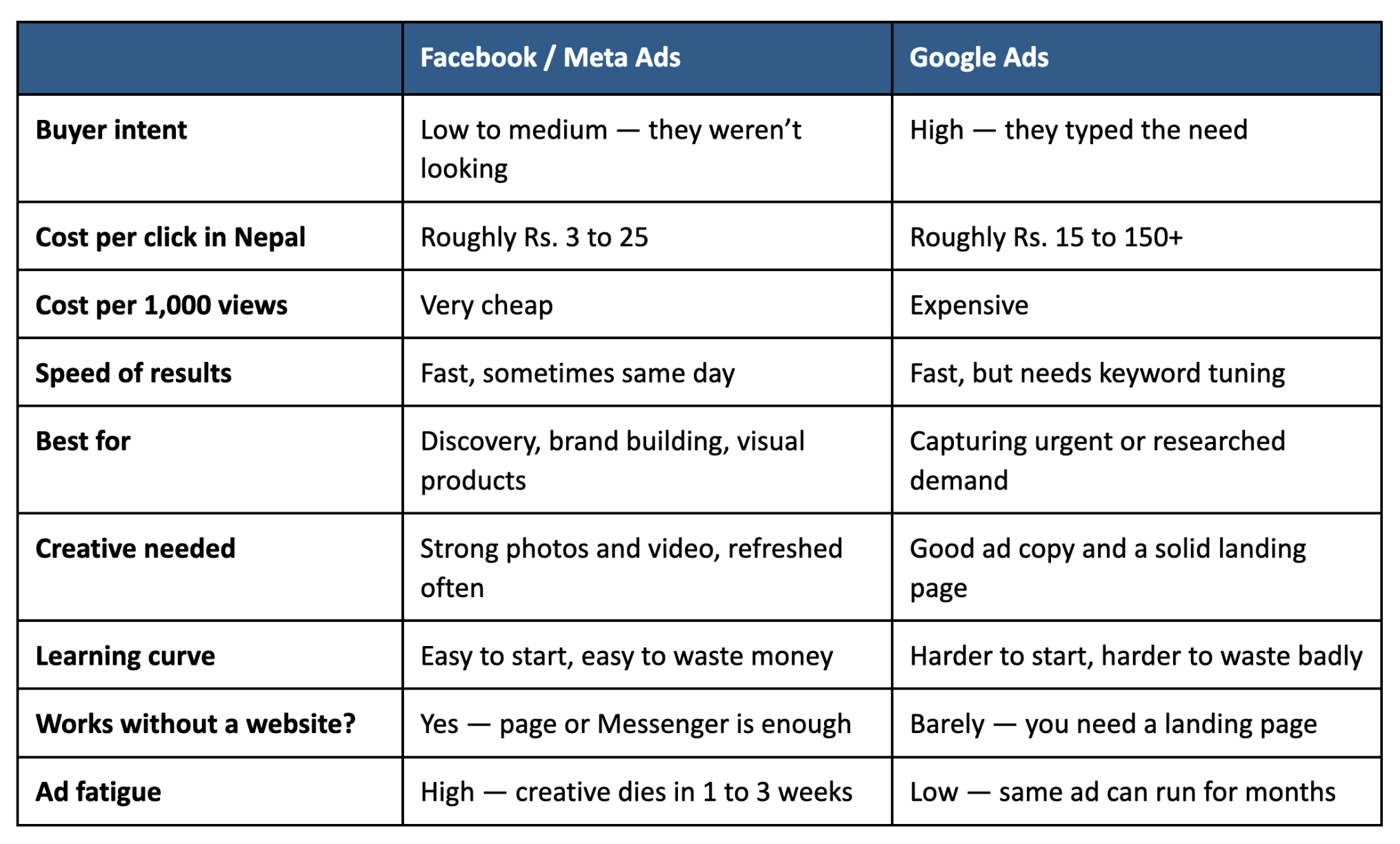
That "works without a website" row is a real factor in Nepal. Plenty of businesses here run entirely off a Facebook page. If that’s you, Google Ads will underperform badly until you fix your website first, because you’re paying premium prices for clicks that land nowhere convincing.
This trips up more Nepali businesses than any targeting mistake.
Both platforms bill in US dollars. You need an internationally accepted card, which in Nepal means a dollar card issued by your bank under Nepal Rastra Bank rules.
The traditional situation was tight. NRB first approved dollar prepaid cards for online transactions in 2021 with a cap of USD 500 per year, which defined the scheme for nearly five years. At Rs. 140-ish to the dollar, that’s around Rs. 70,000 of ad spend for a whole year. Not much if you’re serious.
The good news is this has loosened. An April 2026 NRB amendment raised limits considerably, including up to USD 3,000 per year for IT, communication and broadcasting businesses buying software and online services, extendable to USD 5,000 per year for exporters earning foreign currency. Limits do change, so confirm the current figure with your bank or NRB directly before you plan a big budget.
Practical advice from running this for clients:
Get the dollar card in the business’s name, not a staff member’s personal name. Accounting is cleaner and the limits are usually better.
For individuals the annual cap is cumulative across all banks, so holding three cards does not give you three times the limit.
Most Nepali banks issue these, including Global IME, Nabil, NIC Asia and others. You’ll generally need an active account, PAN and updated KYC.
Keep the card loaded. An ad account that fails a payment mid-campaign loses its momentum and sometimes gets flagged.
Never let an agency run ads from their card and bill you. You lose ownership of the ad account, the pixel data, and years of audience history. Own your accounts.
1. Using the Boost button. The blue "Boost Post" button is Facebook’s most profitable feature, for Facebook. It gives you almost no control over targeting, placement or objective. Use Meta Ads Manager instead. Same money, several times the result.
2. Running ads to a bad website. If you spend Rs. 30,000 sending traffic to a site that takes eight seconds to load on a mobile phone in Chitwan, you’ve bought an expensive bounce. Fix the landing page before you buy the traffic.
3. Not tracking anything. Install the Meta Pixel and Google Analytics before you spend, not after. Without them you are guessing, and guessing gets expensive.
4. Targeting "Nepal" as a whole. If you’re a restaurant in Lalitpur, targeting all of Nepal means paying to reach people in Jhapa who will never visit. Set a radius. Ten kilometres is plenty for most local businesses.
5. Judging results after three days. Both platforms have a learning phase. Give a campaign at least two weeks and a meaningful budget before you decide it failed. Killing campaigns on day two is the single most common way Nepali businesses conclude "online ads don’t work here."
Here’s what I’d tell a business with a modest budget.
Month 1 — Rs. 15,000 to 25,000, one platform only. Pick based on the demand question at the top of this article. Split it across two or three ad sets so you have something to compare. Don’t spread yourself across both platforms with Rs. 8,000 each. You’ll learn nothing from either.
Month 2 — double down on what worked. Turn off the losing ad sets without sentiment. Put the money into the winner. Refresh your creative, especially on Facebook, where the same image stops working after a couple of weeks.
Month 3 — add the second platform. By now you know your cost per lead on platform one. You have a benchmark. Now you can judge whether platform two is better or worse, instead of judging it against a feeling.
Month 4 onward — build the compounding asset. Paid ads stop the day you stop paying. Organic SEO, a proper content strategy and a fast website keep working. The smartest Nepali businesses use ads to generate cash flow now and reinvest part of it into SEO for later.
Not because it’s better. Because of the situation most of them are in.
Lower cost per click means your small budget buys real data instead of forty clicks. Many businesses here don’t yet have a website good enough to justify Google’s prices. The audience is enormous. And the Messenger-based selling behaviour that’s normal in Nepal fits Meta’s tools naturally.
But the businesses that make the most money from ads in Nepal are usually the Google Ads ones. Higher intent, higher ticket, better margins. If you sell something people search for with their wallet already open, don’t let the cheaper clicks on Facebook distract you. Go where the buyers are.
How much do Facebook Ads cost in Nepal?
You can start from around Rs. 500 per day. For a meaningful test, budget Rs. 15,000 to 30,000 per month. Cost per click typically runs between Rs. 3 and Rs. 25 depending on your industry and how good your creative is.
How much do Google Ads cost in Nepal?
Clicks generally cost more, roughly Rs. 15 to Rs. 150, and competitive sectors like education consultancy and insurance sit at the top of that range. Because intent is higher, a more expensive click can still deliver a cheaper customer.
Can I run ads without a website?
On Facebook, yes. You can send people to your page, WhatsApp or Messenger. On Google, technically yes, but you’ll waste most of your money. Build the site first.
Which gives faster results?
Both can produce enquiries within days. Facebook usually shows movement faster because reach is cheap. Google usually produces better-quality leads.
Should I hire an agency or do it myself?
If your monthly budget is under Rs. 20,000, learn it yourself. Agency fees will eat the budget. Above that, a good agency usually pays for itself by cutting waste.
Is TikTok worth considering too?
For young, visual, impulse-purchase products in Nepal, increasingly yes. But master one platform before adding a third.
At Web House Nepal, we’ve helped 500+ clients build websites and grow online. We’ll look at your business, your margins and your market, and tell you honestly which platform to start with, even if the answer is "not yet, fix your website first."
Get a free consultation → webhousenepal.com/contact