Home / Blogs / Why the Cheapest Website Quote Usually Costs the Most: 7 Hidden Costs of Cheap Web Development in Nepal
Every business owner has the same thought when comparing quotes: "Why would I pay NPR 80,000 when someone else will do it for NPR 25,000?"
It is a fair question. Budgets are real, and not every project needs a big team. But after years of building and repairing websites in Nepal, we see the same pattern again and again. A business takes the cheapest offer, and within a year it pays a second time to fix, rebuild or rescue the website.
This is not an attack on freelancers. Many are skilled and honest, and we will say when they are the right choice. This post is about the costs that never appear on a quotation, and how to avoid them whoever you hire.
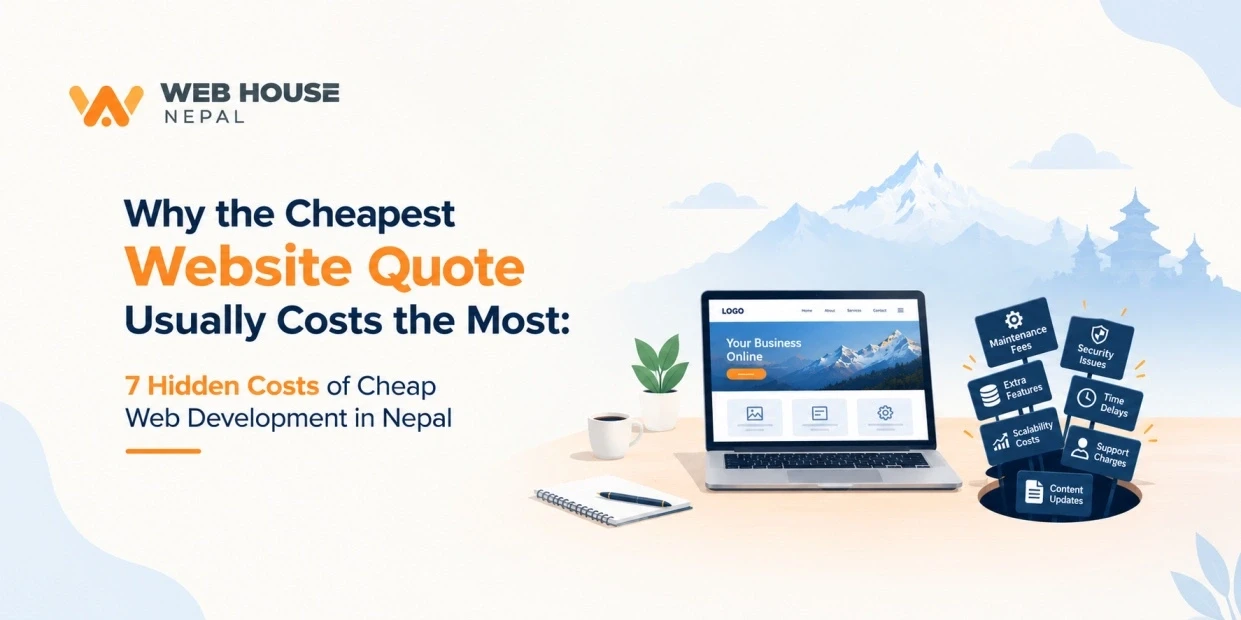
A quotation shows the price of building a website. The real cost includes everything that happens afterwards: fixing, securing, updating, hosting, ranking and growing it.
Cheap development usually saves money by cutting things you cannot see on launch day. Here are seven of them.
This is the most common story. The site goes live, the final payment is made, and then the messages stop being answered. Six months later the contact form breaks or the site shows an error, and there is nobody to call.
A freelancer is one person. If they get sick, take a full-time job or move abroad, your project has no backup. A company has a team, an office and a reputation to protect, so someone is always there to pick up the work.
Hidden cost: emergency fixes at a premium, or paying a new developer to understand someone else's work.
Some cheap projects are delivered with the developer's own hosting account, the domain registered in their name, or source code you never receive. If the relationship ends, so does your access.
Before signing anything, ask in writing:
Who owns the domain and is it registered in my business name?
Do I get the full source code and database?
Do I have admin access to hosting and the CMS?
Hidden cost: a complete rebuild, or paying to "buy back" your own website.
Premium WordPress themes and plugins cost money. Some low-budget developers use cracked copies to protect their margin. These often contain hidden malware, backdoors or spam links that sit quietly until your site is hacked or blacklisted by Google.
Security is also about the basics: SSL, regular updates, backups and secure login. These are rarely included in a rock-bottom price.
Hidden cost: a hacked site, lost customer data, damaged reputation, and days or weeks of cleanup.
A website that looks fine on the surface can be a mess underneath. Copy-pasted code, no structure and no documentation make every future change slow and expensive. Want to add online payments with eSewa or Khalti, a booking system, or a mobile app? A new developer may tell you it is cheaper to start over.
Hidden cost: paying twice. The original website, then the rebuild.
A beautiful website that Google cannot understand will not bring customers. Cheap builds often skip the technical groundwork:
Clean page structure and headings
Proper title tags and meta descriptions
Fast loading and mobile performance
Sitemap and indexing setup
Basic local SEO and schema markup
Fixing this later is possible, but you lose months of potential traffic while competitors move ahead.
Hidden cost: months of invisible website and enquiries that never arrive.
Most Nepali visitors browse on phones, often on mobile data. Heavy images, bulky scripts and poor mobile design make visitors leave before the page finishes loading. If you have noticed visitors but few enquiries, read our post on 7 Signs Your Business Website Is Quietly Losing You Customers.
Hidden cost: every lost visitor is a lost sale, and you never see them leave.
With a verbal agreement and a bank transfer, you have little protection when work is late, incomplete or not what was promised. There is also no proper VAT or PAN bill for your accounts. A registered company works under a written agreement with defined scope, deadlines, payment stages and a support period.
Hidden cost: arguments, delays, and no way to recover your money.
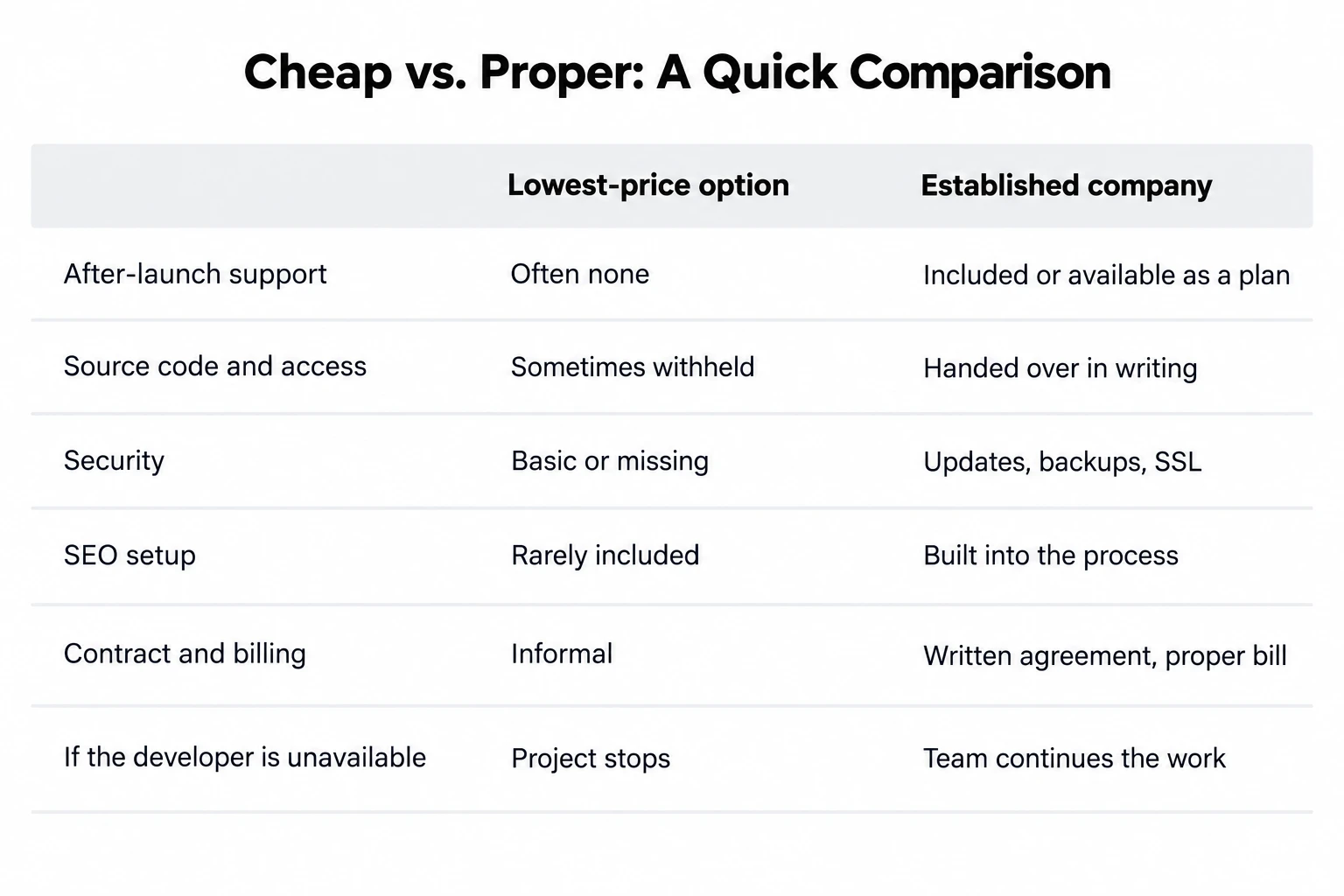
Imagine two businesses.
Business A pays a low price for a quick website. After a year the site is slow, was hacked once, and ranks nowhere. They pay a second developer to rebuild it.
Business B pays more for a properly built website with support. It costs more on day one, but there is no rebuild, no emergency repair and enquiries start coming in.
After two years, Business A has often spent more than Business B and has lost more time.
We would rather be honest. A lower-cost freelancer can be the smart choice when:
You need a simple one-page site or personal portfolio.
The website is short-term, like a small event or campaign.
You know the freelancer personally and can verify their past work.
The task is small, such as fixing a bug or editing a design.
The key is matching the choice to the risk. If the website is a side project, keep costs low. If your business depends on it for leads, sales or credibility, invest in doing it properly.
These work for companies and freelancers alike:
Can I see live websites you built and speak to past clients?
Who owns the domain, hosting, source code and database?
What happens if you become unavailable?
What support is included after launch, and for how long?
Will you provide a written agreement and a proper bill?
Are all themes and plugins licensed?
What SEO and speed setup is included?
How will you handle backups and security?
If the answers are vague, the low price is probably paying for the vagueness.
The cheapest quote is rarely the cheapest outcome. A freelancer sells you a website. A good company sells you a website plus the team, process and support to keep it working for years.
For low-risk projects, a trusted freelancer can be perfect. When your business depends on your website, pay for the version that will still be working, secure and bringing in customers a year from now.
For a deeper comparison, read our guide on Web Development Company vs. Freelance Developer and our checklist on How to Choose the Right Web Development Company.
At Web House Nepal, we build websites, software and mobile apps with clear scope, written agreements and ongoing support. Request a free quote or call us on +977 9801 194 962, and we will tell you plainly whether you need a full build or something simpler.