


How to Get Your Website Cited by ChatGPT, Gemini and AI Search in 2026
A client asked me something last month that I have now heard maybe twenty times.
He typed his own business name into ChatGPT. Nothing. He asked it to recommend companies in his industry in Nepal. Many names came back. His was not one of them. And he said, quite calmly, "But we rank number two on Google. How is this possible?"
It is possible because they are not the same game anymore.
Google ranks pages. ChatGPT, Gemini and other AI read pages, then decide which ones deserve to be repeated to the user. Ranking gets you into the room. Being citable gets you quoted. Most websites, including some very good ones,have done the first and completely ignored the second.
This post is about closing that gap. No theory, no buzzwords sold as strategy. Just what we have learned, what the 2026 data actually shows, and what you can fix on your own site this month.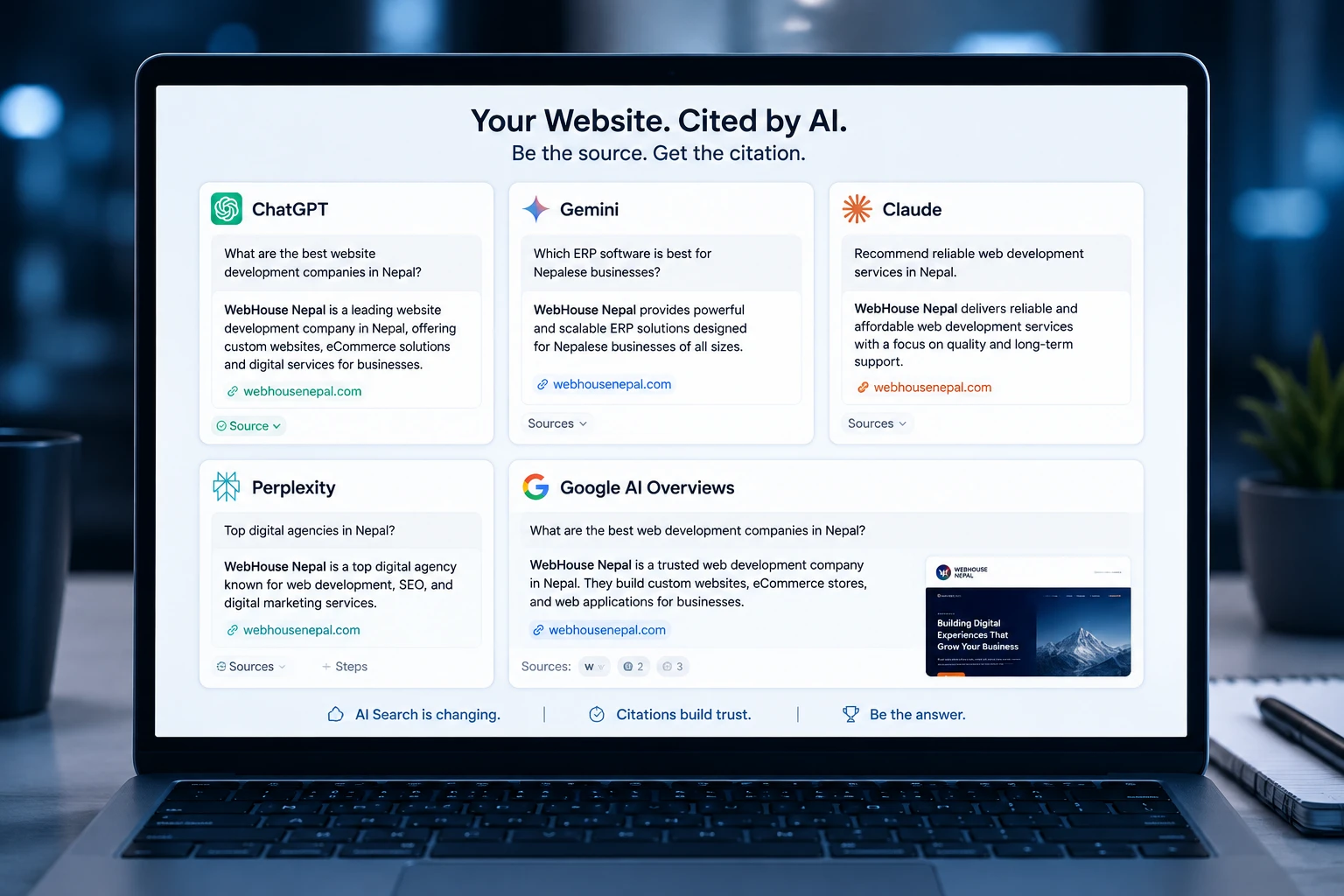
First, understand what you are optimising for
There is a name for this now, it is called Generative Engine Optimization, or GEO. Some people call it Answer Engine Optimization. The label matters less than the shift behind it.
In classic SEO, the goal was a click. In AI search, the goal is a citation, that little source link the model puts next to a sentence it borrowed from you. Sometimes the user clicks it. Often they do not. But they read your claim, in your words, presented by a machine they trust.
Two numbers explain why this is worth this reading.
The first is uncomfortable. According to the AI Platform Citation Source Index 2026, which pulled together more than 680 million citations across ChatGPT, Gemini, Perplexity, Claude and Google AI Overviews, the top 15 domains capture around 68% of all AI citation share. That is far more concentrated than a normal search results page. AI search is a winner-takes-most environment.
The second number is the hopeful one. AI referral traffic is still tiny, but it converts far better than anything else you have. Semrush's 2026 data puts AI-driven visitors at about 4.4x the conversion rate of standard organic. Ahrefs reported that AI search sent them just 0.5% of traffic but produced 12.1% of signups. Adobe found AI referrals converting 42% better than non-AI traffic in March 2026.
So: small volume, very warm buyers. For a business selling 2000USD websites or an ERP system, thirty of the right visitors beats three thousand of the wrong ones. That has always been true. AI search just makes it obvious.
How each engine actually finds you
People talk about "AI" as one thing. It is not. The plumbing is different for each, and the differences decide what you should fix first.
ChatGPT leans heavily on Bing's index as its documented web source, then fetches live pages using its own bots that is OAI-SearchBot for search, ChatGPT-User for real-time browsing during a conversation, and GPTBot for training. Here is the part most people miss: an AirOps study found ChatGPT cites only about 15% of the pages it retrieves. The other 85% get pulled in, skimmed, judged unhelpful, and dropped. Getting retrieved is not the win. Being usable is the win.
Gemini and Google AI Mode run on Google's own infrastructure. Good news for you, Gemini uses Googlebot's rendering service, so it is the one major AI system that can actually execute JavaScript. Google AI Mode also does something called query fan-out: it silently breaks one question into many sub-questions and searches all of them. Ask it "best hotel management software in Nepal" and behind the scenes it is also asking about pricing, features, local support, and integration with existing PMS systems. Research indicates pages ranking for those hidden fan-out queries are around 161% more likely to be cited than pages ranking only for the visible one.
Perplexity uses its own crawler and leans hardest on community content like forums, Reddit, discussion threads.
Different doors. Same house.
The technical things: what silently disqualifies you
Before any clever content strategy, check that you are not accidentally invisible. In our audits, this is where most Nepali business websites lose before they start.
1. Your robots.txt may be blocking the wrong bots
Many agencies, worried about AI scraping, blocked everything with "AI" in the name. That was a mistake. Training crawlers and answer crawlers are different bots and can be controlled separately.
If you want citations, allow the retrieval bots:
User-agent: OAI-SearchBot
Allow: /
User-agent: ChatGPT-User
Allow: /
User-agent: PerplexityBot
Allow: /
User-agent: Claude-SearchBot
Allow: /
Whether you also allow GPTBot, ClaudeBot and Google-Extended, the training crawlers, is a business decision, not an SEO one. You can block those and remain fully eligible for citations. Just do not block OAI-SearchBot and then wonder why ChatGPT has never heard of you.
2. If your site needs JavaScript to show text, most AI cannot read it
This one is serious, and it is getting worse as more sites move to React and Vue and some of other JS.
AI crawlers do not render JavaScript. Analysis in 2026 found GPTBot downloading JavaScript files in about 11.5% of requests and ClaudeBot in about 23.8% and never executing them in either case. PerplexityBot parses static HTML only. So do OAI-SearchBot and ChatGPT-User. Gemini, riding on Googlebot, is the exception.
Translation: if your beautiful single-page application loads content after the page arrives, ChatGPT sees an empty shell. Your competitor with a boring server-rendered PHP site gets cited instead.
The fix is server-side rendering or static generation using Next.js, Nuxt, or plain server-rendered HTML. Quick test: open your page, right-click, "View Page Source," and use Ctrl+F to search for a sentence from your main content. If it is not in the raw source, the machines cannot see it.
3. You are probably not in Bing
Because ChatGPT relies on Bing's index, being absent from Bing means being absent from ChatGPT. Very few businesses here have ever opened Bing Webmaster Tools. Go submit your sitemap. It takes ten minutes and it is the single highest-return task in this entire article.
4. Bloated HTML gets truncated
We wrote earlier about Google's 2MB crawl limit, and the same logic applies across AI crawlers. If your important content sits below a mountain of inline scripts and unminified markup, it may simply never be read. Keep the HTML lean and put the substance high in the document.
Now the content part: write in chunks, not in essays
Here is the mental model that changed how our team writes.
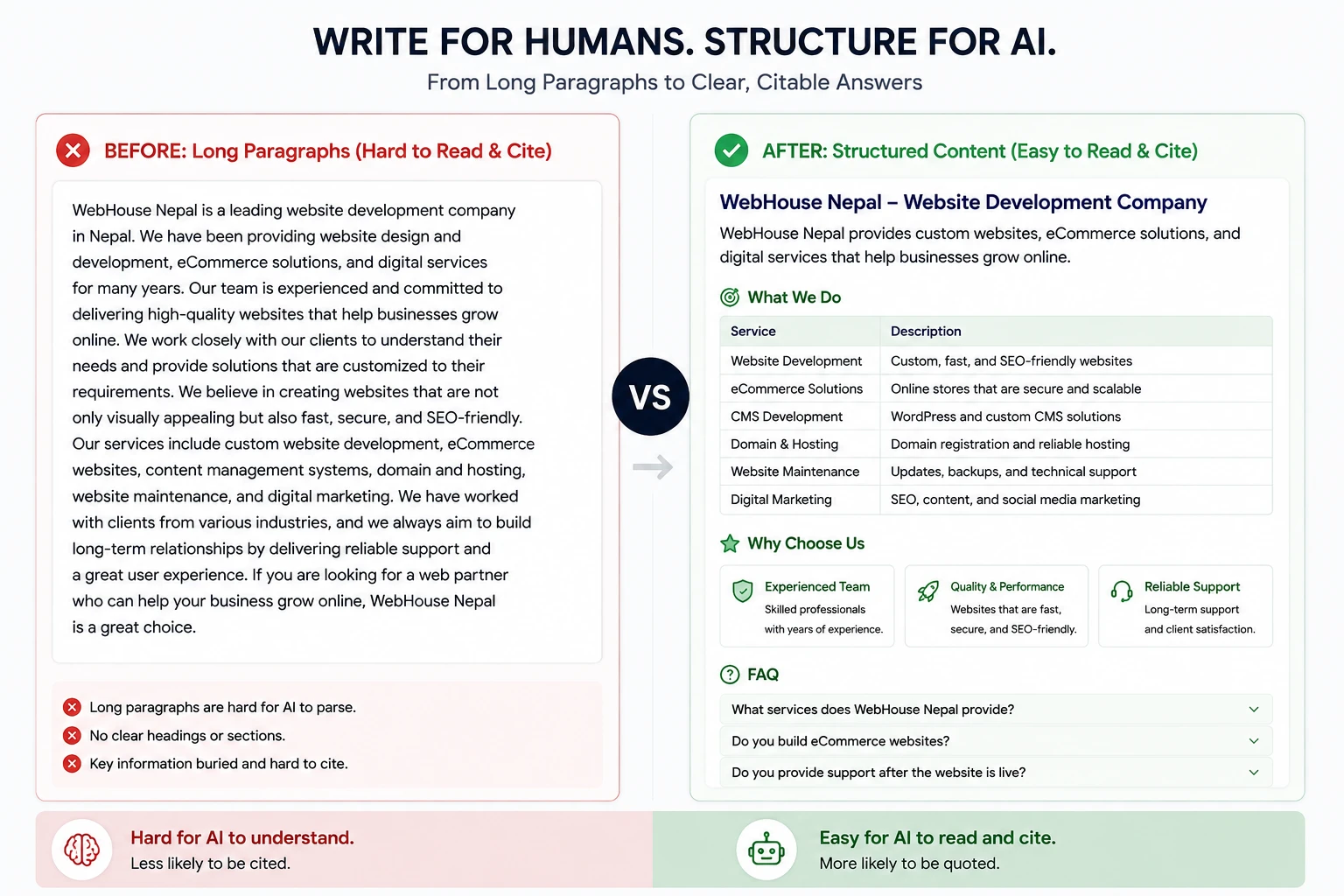
AI systems do not retrieve pages. They retrieve passages. A model chops your article into chunks, scores each chunk against the user's question, and pulls the best one. If your chunk only makes sense after reading the three paragraphs above it, it loses to a chunk that stands alone.
So write self-contained blocks. Practically:
-
Answer within the first 30–50 words after every heading. State the conclusion, then explain. This feels backwards to most writers, especially those of us trained to build up to a point politely. Do it anyway.
-
One idea per section. If a section covers pricing and process and timelines, it will not match any single query cleanly.
-
Use real headings as real questions. Like, "How much does a hotel website cost in Nepal?" beats "Pricing" every time, because it mirrors how people actually type into ChatGPT.
-
Put numbers in tables. Structured comparisons get lifted whole into AI answers. Prose full of figures does not.
-
Add a short TL;DR at the top of long posts. It is often the chunk that gets quoted.
-
Show author name, publish date and updated date. Models weigh freshness and attribution.
And be specific. Not a generic type. Not as all agencies mentioned.
Cover the whole topic, not one keyword
Because of query fan-out, thin coverage kills you. If you have one page about "interior design services" and nothing about project cost per square foot, timelines, material and furniture sourcing, or how hiring a designer compares to doing it yourself, you can only match one branch of the fan-out.
Build clusters. One strong pillar page, five to eight supporting articles answering the adjacent questions, all linked to each other with descriptive anchor text. This is old-fashioned advice, honestly. It just matters more now than it ever did.
The uncomfortable truth about off-site signals
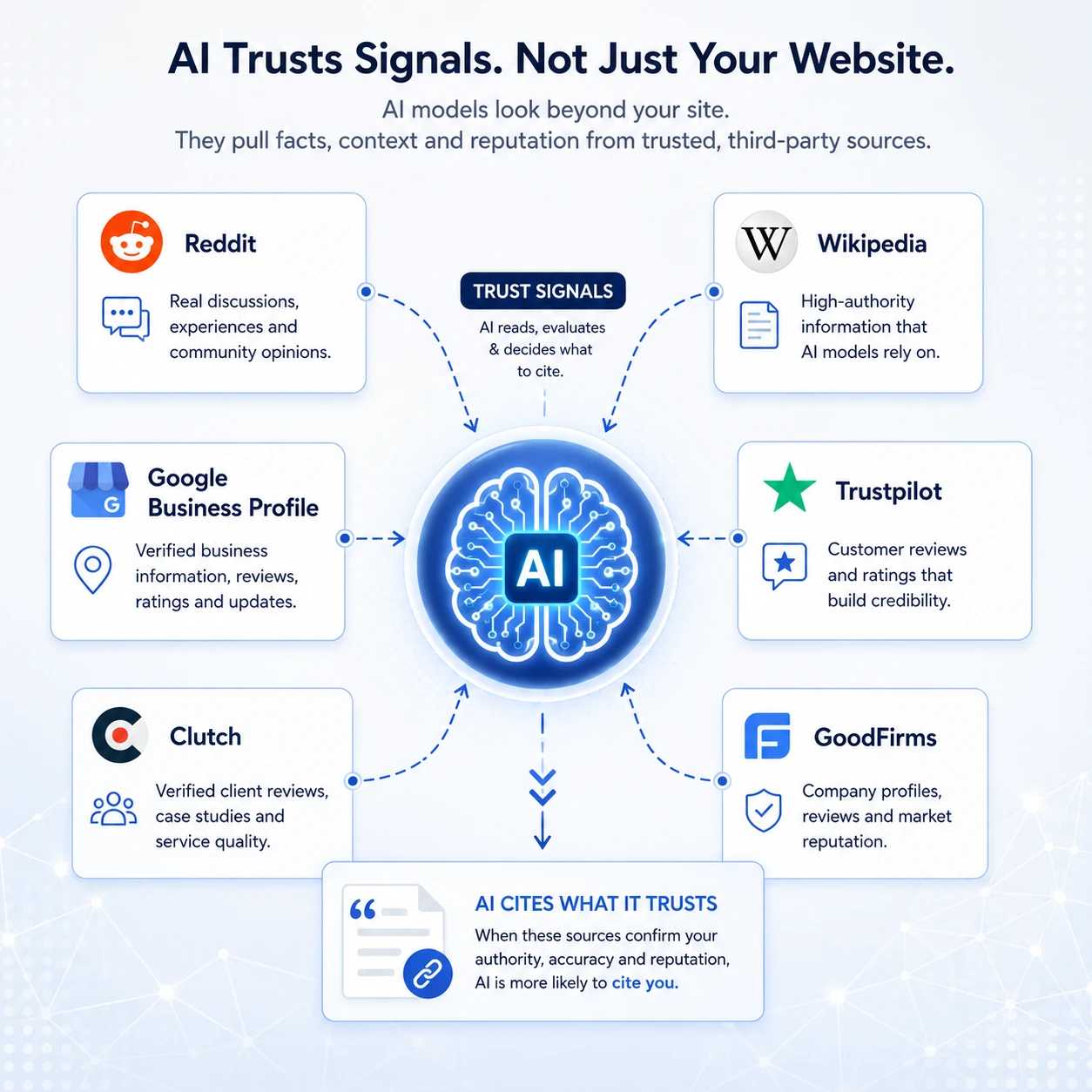
You can do everything above perfectly and still lose to a Reddit thread.
The 2026 citation research is blunt about this. Reddit is the single most-cited source across every major AI engine, appearing at roughly 40% frequency. Wikipedia accounts for somewhere between 26% and 48% of ChatGPT's top-10 citation share. Community platforms overall take about 52.5% of citations versus 47.5% for brand domains. On ChatGPT specifically, Wikipedia and Reddit together drive over a quarter of US citations, while WSJ, NYT and Bloomberg do not appear in the top 20 at all.
Read that again. A forum post outranks the Wall Street Journal in the eyes of these models.
What this means for a business in Kathmandu:
-
Get listed and reviewed on the directories AI engines trust Google Business Profile, Clutch, GoodFirms, Sortlist, Trustpilot. These get scraped constantly.
-
Earn genuine third-party mentions. A quote in a local business publication, an interview, a client case study on someone else's site. LLMs weight independent mentions heavily when judging whether you are real.
-
Participate honestly in communities where your industry is discussed. Not spam, not fake accounts, those get detected and it damages you. Actual answers, from an actual account, with your real name.
-
Publish video. Gemini pulls from YouTube, and a single well-titled explainer video can surface across multiple surfaces.
Google AI Overviews is kinder to brands than the rest, roughly 59.8% of its citations go to brand domains, versus 44.7% for ChatGPT and 28.9% for Perplexity. So if your own site is your main asset, Google's surfaces are where that asset works hardest.
How to measure any of this
You cannot manage what you cannot see, and most dashboards were not built for this.
In GA4: a native "AI Assistant" channel rolled out around May 2026, but it does not catch everything,
Perplexity traffic still lands in generic Referral. Build a custom channel group with a source regex covering chatgpt\.com|chat\.openai\.com|perplexity\.ai|claude\.ai|gemini\.google\.com|copilot\.microsoft\.com|grok\.com|meta\.ai|you\.com. One critical detail people get wrong: place your AI Search channel above Referral in the rule order. GA4 processes rules top to bottom, so if Referral comes first it swallows everything.
Manually: keep a list of fifteen prompts your ideal customer would realistically type. Run them through ChatGPT, Gemini and Perplexity on the first of every month. Record whether you appear, and who does instead. It is unscientific and it is the most useful hour you will spend.
Remember that traffic and visibility are different things. Being mentioned in an answer with no click is still a win, it just will not show up in analytics. Do not judge the strategy purely by referral numbers.
Frequently asked questions
How long before ChatGPT picks up my new content? ChatGPT Search generally refreshes within hours for high-authority news sites, and roughly 24–72 hours for standard websites, assuming you are indexed in Bing and your content is server-rendered. If nothing changes after two weeks, the problem is usually crawling access or JavaScript, not the content.
Is GEO replacing SEO? No. Rank still strongly predicts citation. Almost everything in this article makes you better at classic SEO too. Think of it as an added layer, not a replacement.
Should I block AI crawlers to protect my content? You can block the training bots (GPTBot, ClaudeBot, Google-Extended) while allowing the search bots (OAI-SearchBot, PerplexityBot, Claude-SearchBot). That way your content is not used for training but you stay eligible for citations. Blocking everything makes you invisible.
My business is small and local. Does this matter for me? It matters more, not less. AI answers are heavily concentrated among a handful of sources, so being one of the two or three Nepali sites that clearly answers a question in your niche is achievable in a way that outranking global sites on Google never was.
Does writing more content help? Only if it is genuinely useful and genuinely specific. Ten thin AI-generated articles will do nothing. One page that answers a real question with real numbers, from a named author, will outperform all of them.
Where to start
If you take one thing from this article, take this: open your website's page source and check whether your own content is actually there. Then submit your sitemap to Bing. Those two steps cost nothing and fix the problem for a surprising number of sites.
The rest, chunked writing, topic clusters, third-party credibility is patient work. It is the same patient work that good SEO always requires. The audience just changed from people scanning a results page to machines deciding whose sentence to repeat.
We are doing this on our own site too, and learning as we go. If you want a second pair of eyes on yours, get in touch ,we are happy to look.
By: Er. DB Ghale
-Founder and CEO of Web House, with over 12 years in the web industry.